
CM Punjab Solar Panel Scheme 2026
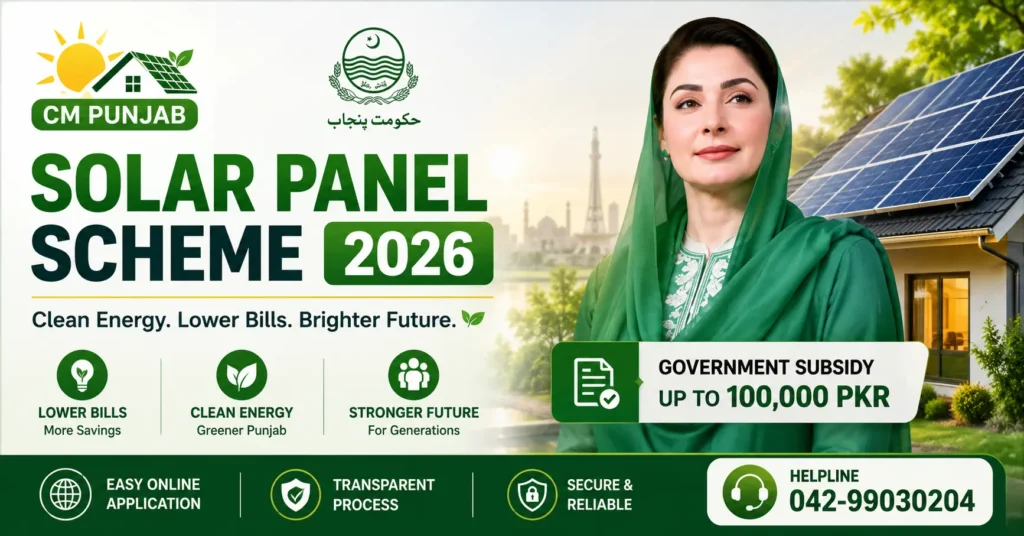
The CM Punjab Solar Panel Scheme, officially called the Roshan Gharana Solar Program, is one of the largest residential solar subsidies Pakistan has seen. Chief Minister Maryam Nawaz Sharif launched it to deliver free 1 kW to 3 kW solar systems to low-income households across Punjab, targeting families who consume between 50 and 300 units per month and cannot access commercial solar on their own.
Before we go further: if you want to understand what a private solar system actually costs without the subsidy, check our 3kW solar system price guide or the current solar panel price in Pakistan for today’s market rates.
What Is the CM Punjab Solar Panel Scheme?
The Roshan Gharana Solar Program is a fully government-funded solar installation initiative by the Government of Punjab. There is no upfront cost for selected beneficiaries. The scheme operates in phases, and the subsidy level and system size depend on your monthly electricity consumption.
| Phase / Tier | Monthly Units | System Size | Key Components Provided |
|---|---|---|---|
| Tier 1 (Basic) | 50-100 units | 1 kW | Panels, certified inverter, safe electrical wiring |
| Tier 2 (Standard) | 101-200 units | 2 kW | Panels, hybrid inverter, battery backup, wiring |
| Tier 3 (Extended) | 201-300 units | 3 kW | High-efficiency panels, hybrid inverter, battery bank, wiring |
Scheme note: Tier allocations are based on official program documentation as of July 2026. Confirm your tier with the verification team after selection, as system sizing may be revised between phases.
Commercial consumers, industrial consumers, and anyone already receiving a solar subsidy from another government program are excluded. This is a domestic users-only scheme.
Who Is Eligible for the Scheme?
The eligibility criteria are strict. Meeting most of them is not enough, you must meet all of them.
- You are a permanent resident of Punjab with a valid CNIC
- Your electricity connection is domestic, not commercial or industrial
- Your monthly usage falls between 50 and 300 units
- You have no history of electricity theft and are not listed as a utility payment defaulter
- You belong to a priority group: low-income households, women-led households, widows, disabled citizens, or rural residents
You are disqualified if your connection shows commercial or industrial usage, you have outstanding dues flagged by your DISCO, or you have already benefited from a similar federal or provincial solar energy program.
One detail competitors consistently miss: a landlord NOC is required if you are a tenant. You need either an ownership deed or a signed no-objection letter from your landlord before your application is processed.
What Documents Do You Need to Apply?
Application rejections in Phase 1 were heavily concentrated around three errors: mismatched CNIC details, missing landlord NOC, and electricity bill names not matching the applicant’s CNIC. Get these right before you submit.
If your bill is in a family member’s name, the program requires a written declaration plus that member’s CNIC. Don’t skip this it’s one of the top reasons for rejection.
How to Apply for CM Punjab Solar Panel Scheme?
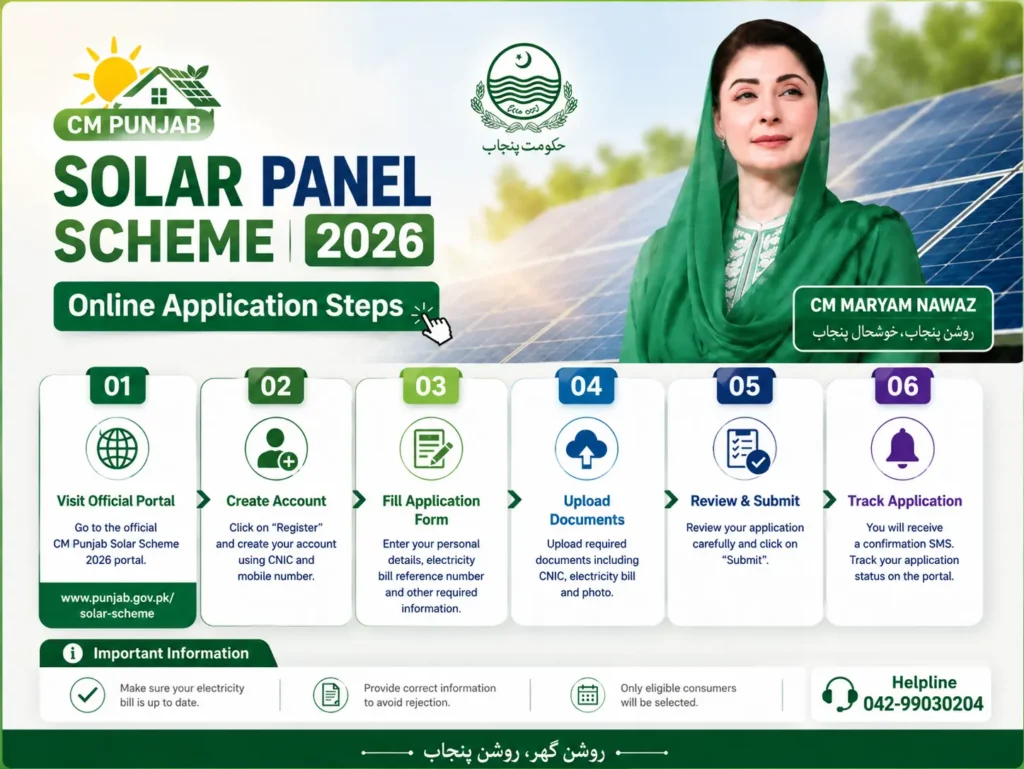
The program offers both online and offline application routes.
- Visit the official portal at punjab.gov.pk and go to the Roshan Gharana section
- Complete CNIC registration and mobile number registration
- Upload your electricity bill, CNIC copy, and residence proof
- Submit and record your application reference number
- Wait for SMS confirmation, sent to your registered mobile number
- Visit a Bank of Punjab branch or a designated government facilitation centre in your district
- Submit physical copies of all documents listed above
- You can also SMS shortcode 8800 with your CNIC number to check eligibility before visiting
Registration re-opens periodically between phases. If the portal shows “closed,” check back, as Phase 2 expansion was confirmed for additional districts in 2026.
Selection Process, Installation and Net Metering
Selection uses a computerised balloting process to ensure fairness across all districts. Priority weighting goes to widows, disabled citizens, women-led households, and rural applicants.
After selection you receive an SMS update. Government teams then schedule physical verification of your property, covering roof condition, electrical wiring status, and load assessment. Professional installation follows within the scheduled window.
On net metering: Tier 2 and Tier 3 systems, with hybrid inverters and battery backup, are technically capable of net metering, but eligibility depends on your DISCO and transformer capacity.
Under NEPRA’s updated Prosumer Regulations, new net billing connections receive buyback at approximately PKR 11 to 13 per unit, not the old retail rate. For 1-3 kW systems the real financial value comes from self-consumption during the day and battery backup at night, not from grid export. Verify net metering eligibility directly with your DISCO after installation before expecting any export credit.
CM Punjab Scheme vs Other Solar Programs
How does this compare to other programs? Here is an honest side-by-side.
| Program | Province | Target | System Size | Battery | Application Route |
|---|---|---|---|---|---|
| Roshan Gharana (CM Punjab) | Punjab | Low-income residential | 1-3 kW | Yes (Tier 2-3) | Online / BOP / SMS 8800 |
| PM’s Solar Initiative | Federal | 100W kits (rural) | Off-grid only | Basic | BISP-linked |
| KP Solar Program | KPK | Rural / off-grid | 0.5-1 kW | Basic | Offline / DC offices |
The CM Punjab Solar Panel Scheme is the only provincial program providing hybrid solar solutions with certified inverter systems and battery storage at this scale.
The federal PM initiative targets BISP beneficiaries with much smaller off-grid kits, which are not comparable for household load coverage.
Real Savings and Environmental Impact
Beneficiary households in Phase 1 reported monthly savings of PKR 3,000 to PKR 6,000, depending on consumption and system size. A family in Faisalabad with a 2 kW Tier 2 system on 180 units per month reported their bill dropping from roughly PKR 5,200 to under PKR 1,500. That is consistent with realistic self-consumption maths for a 2 kW system producing 8 to 10 kWh per day in Punjab’s sun conditions.
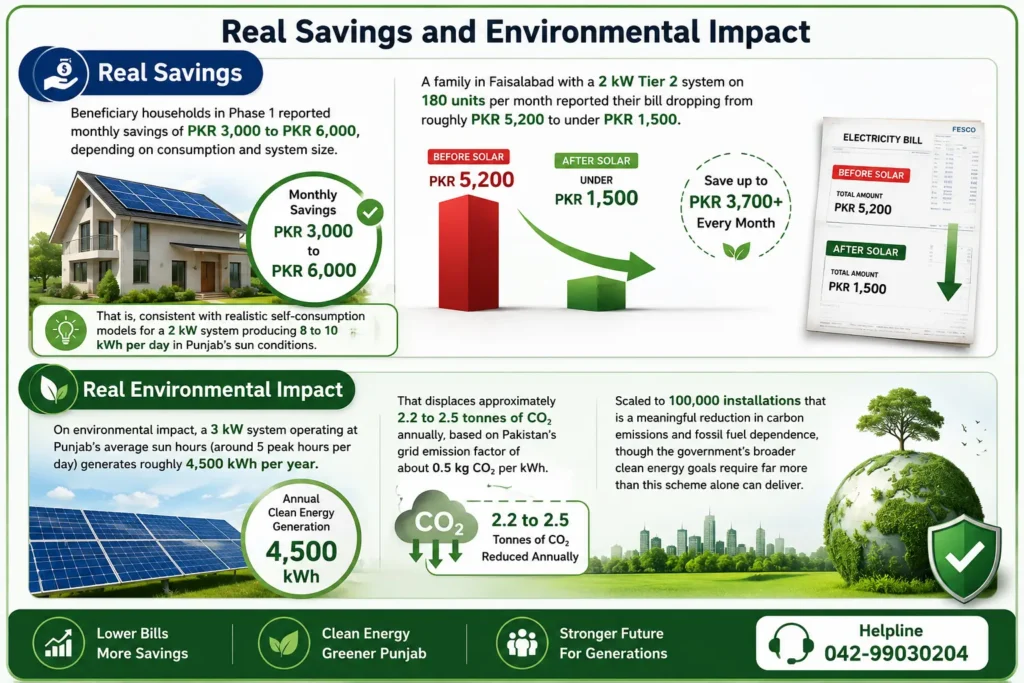
On environmental impact, a 3 kW system operating at Punjab’s average sun hours (around 5 peak hours per day) generates roughly 4,500 kWh per year. That displaces approximately 2.2 to 2.5 tonnes of CO₂ annually, based on Pakistan’s grid emission factor of about 0.5 kg CO₂ per kWh.
Scaled to 100,000 installations that is a meaningful reduction in carbon emissions and fossil fuel dependence, though the government’s broader clean energy goals require far more than this scheme alone can deliver.
Maintenance, Repairs and Warranty
For maintenance, clean your panels every 2 to 4 weeks during Punjab’s summer dust season, as dirty panels lose 15 to 25 percent of their output. Battery systems need monthly electrolyte checks if tubular lead-acid chemistry is used. Avoid deep-discharging below 50 percent depth of discharge, which shortens battery life significantly.
Check our Osaka battery price guide and Phoenix battery prices if you need a replacement unit after the warranty expires. For inverter support outside warranty, Inverex inverter prices and Growatt inverter prices are both worth checking, since both brands are common in government-deployed systems.
Final Words
The CM Punjab Solar Panel Scheme is a real and meaningful energy relief program for Punjab’s lower-income households. The balloting process adds genuine fairness, priority weighting for vulnerable groups is well-structured, and including battery backup in Tier 2 and Tier 3 makes it far more useful than solar-only schemes that leave you without power at night or during load-shedding.
What it is not: a guaranteed path to zero electricity bills, a fast process, or accessible to everyone. Verify your documents before applying, confirm your district is active, and understand that net metering registration is your own responsibility after installation.

